Overview
Polyamide strips are used in thermal break aluminum profiles to separate the inner and outer aluminum sections and reduce heat transfer through the frame. The strip is installed into specially designed grooves and then mechanically secured to form the finished thermal break profile.
So, how are polyamide strips inserted into aluminum profiles?
The typical process includes profile preparation, knurling, polyamide strip insertion and rolling crimping. Each step plays a different role in creating a secure connection between the aluminum profile and the thermal barrier strip.

What Is a Polyamide Strip?
A polyamide strip is an insulating component used between two aluminum profile sections. PA66, often reinforced with glass fiber, is commonly used for thermal break aluminum windows, doors and curtain wall systems.
The strip separates the two aluminum sections while maintaining their mechanical connection. Its shape and dimensions depend on the profile design. Common types include I-shaped, C-shaped, T-shaped and hollow strips.
How Are Polyamide Strips Inserted Into Aluminum Profiles?
The basic process is:
Profile Preparation → Knurling → Strip Insertion → Rolling Crimping
1. Profile Preparation
The aluminum profile needs to have the correct thermal break grooves before the polyamide strip is inserted.
The groove dimensions must match the strip specifications. The profile is positioned and guided before entering the knurling process.
2. Profile Knurling
Knurling prepares the inner surface of the thermal break groove.
A knurling tool rolls along the groove and forms a regular tooth or serration pattern on the aluminum surface. These teeth provide mechanical engagement between the aluminum profile and the polyamide strip during the following crimping process.
CNC knurling equipment can control the processing position and depth according to the profile design.
For dual-station systems, the upper and lower sides of the profile can be processed without manually turning the profile between operations.
3. Polyamide Strip Insertion
After knurling, the polyamide strip is fed into the aluminum profile.
The strip is guided into the corresponding grooves on the aluminum sections and needs to remain correctly aligned during insertion. The strip should be fully seated in the grooves before the profile enters the rolling crimping process.
Depending on the profile system, the machine may be configured for different strip shapes and sizes.
4. Rolling Crimping
Strip insertion alone does not complete the assembly.
The assembled profile passes through a rolling crimping machine, where controlled pressure is applied to deform the aluminum around the polyamide strip.
This process locks the aluminum sections and polyamide strip together and creates the required mechanical connection.
The rolling parameters depend on the profile design, groove dimensions and strip configuration.
Why Is Knurling Required?
Knurling creates a tooth pattern on the aluminum groove surface, providing mechanical engagement between the aluminum and polyamide strip.
The three main processes have different functions:
Knurling: prepares the aluminum groove surface.
Strip insertion: positions the polyamide thermal barrier strip.
Rolling crimping: mechanically locks the assembled components together.
For this reason, thermal break profile production is more than simply inserting a strip into an aluminum profile.
What Types of Polyamide Strips Can Be Used?
The strip type depends on the aluminum profile design.
Common configurations include:
I-shaped polyamide strips
C-shaped polyamide strips
T-shaped polyamide strips
Hollow polyamide strips
Cut-to-length strips
The strip dimensions must match the aluminum groove. Profile drawings, groove dimensions and strip specifications should be checked before selecting the assembly equipment.
Automatic Polyamide Strip Insertion
Polyamide strips can be inserted manually for small production runs. For larger production volumes, the process can be automated.
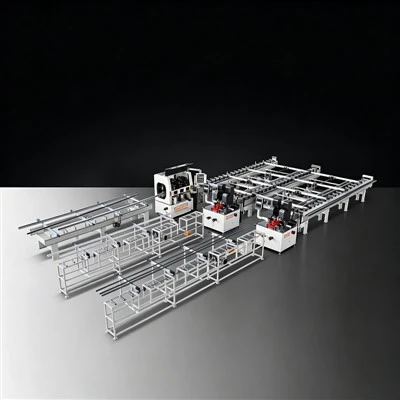
A typical automatic thermal break assembly line combines:
Profile Feeding → CNC Knurling → Polyamide Strip Insertion → Rolling Crimping
This reduces manual handling and helps maintain consistent profile positioning during production.
The MAKERL T700Pro Intelligent Thermal Break Assembly Line combines a CNC 12-axis dual-station knurling and strip insertion machine with a CNC rolling crimping machine and automatic conveying system.
The dual-station design allows both sides of the aluminum profile to be processed without manually turning the profile between knurling operations.
What Affects Polyamide Strip Assembly Quality?
The final assembly quality depends mainly on the groove dimensions, knurling depth, strip positioning and rolling pressure.
These parameters need to match the aluminum profile and polyamide strip specifications. Profile straightness and dimensional consistency can also affect the insertion and rolling processes.
FAQ
What is the purpose of a polyamide strip in an aluminum profile?
A polyamide strip separates the inner and outer aluminum sections and helps reduce heat transfer through the profile. It is commonly used in thermally broken aluminum windows, doors and curtain wall systems.
Does the aluminum profile need to be knurled before strip insertion?
For thermal break systems using mechanically engaged grooves, knurling creates a tooth pattern on the groove surface before strip insertion and rolling crimping.
Is polyamide strip insertion enough to secure the profile?
No. Strip insertion positions the polyamide strip in the grooves. Rolling crimping then deforms the aluminum around the strip to create the required mechanical connection.
Can different polyamide strip shapes be processed?
It depends on the machine configuration, tooling and profile design. Different strip shapes and profile geometries may require different settings or tooling.
Can polyamide strip insertion be automated?
Yes. Automatic thermal break assembly lines can combine profile feeding, knurling, strip insertion and rolling crimping into a continuous production process.
Conclusion
Polyamide strip insertion is an important part of thermal break aluminum profile production, but it is only one step of the complete assembly process.
The typical sequence is knurling, polyamide strip insertion and rolling crimping. Knurling prepares the aluminum groove, strip insertion positions the thermal barrier, and rolling crimping creates the final mechanical connection.
For higher-volume production, an automatic thermal break assembly line can integrate these processes into a continuous production system. The machine configuration should be selected according to the aluminum profile design, polyamide strip type and required production capacity.