Aluminum is widely used for windows, doors, curtain walls, skylights, and other building envelope systems because it is strong, lightweight, durable, and relatively easy to fabricate.
There is one important limitation, however: aluminum conducts heat very efficiently.
A conventional aluminum frame can create a continuous thermal path between the exterior and interior of a building. In cold weather, heat can move outward through the frame. In hot climates, unwanted heat can move inward. This can affect energy performance, interior comfort, and condensation control.
A thermally broken aluminum profile addresses this problem by separating the inner and outer aluminum sections with a low-conductivity thermal barrier.
The basic principle is simple:
Aluminum → Thermal Barrier → Aluminum
The actual systems used in Europe and North America are much more diverse than this simple cross-section suggests. Different window and door designs use different frame depths, thermal barrier widths, materials, glazing configurations, and connection methods.
This guide explains the main types of thermally broken aluminum profiles used in European and North American markets, the thermal barrier technologies behind them, and how polyamide-based profiles are manufactured.
What Is a Thermally Broken Aluminum Profile?
A thermally broken aluminum profile consists of separate aluminum sections connected by an insulating material.
In a conventional aluminum profile, the metal provides a continuous path for heat transfer. A thermal break interrupts this path.
●The result is a composite profile with:
●An exterior aluminum section
●An interior aluminum section
●A thermal barrier between them
●Mechanical or structural connections that keep the profile stable
The purpose is not simply to "stop heat." The thermal break reduces heat transfer through the frame and helps improve the thermal performance of the finished window, door, or façade system.
FGIA describes thermal barriers as resin-based components that create a thermal break between the inner and outer surfaces of aluminum fenestration systems. The organization also notes that thermal barriers can improve the U-value characteristics of finished systems.
It is important to distinguish the thermal performance of the profile from the performance of the complete window or door.
The final result also depends on factors such as:
●Frame geometry
●Thermal barrier design
●Glazing
●Glass spacer
●Gaskets and seals
●Frame-to-glass ratio
●Installation
●Overall system design
For this reason, a wider thermal barrier does not automatically mean that an entire window will have a proportionally lower U-value.

Main Types of Thermally Broken Aluminum Profiles
Thermally broken aluminum profiles can be classified in several ways.
The most useful approach for architects, fabricators, and manufacturers is to look at them by application, system design, and thermal barrier technology.
The major applications include:
Thermally broken window profiles
Thermally broken door profiles
Thermally broken sliding door profiles
Thermally broken curtain wall profiles
Thermally broken storefront profiles
Thermally broken skylight and roof profiles
High-performance and low-energy building systems
1. Thermally Broken Aluminum Window Profiles
Windows are one of the largest application areas for thermally broken aluminum profiles.
European and North American window systems include many different opening configurations. The thermal break is integrated into the frame and sash sections to reduce heat transfer through the aluminum structure.
Tilt and Turn Windows
Tilt and turn windows are particularly common in European markets.
The same sash can normally operate in two positions:
●Tilt inward for ventilation
●Turn inward for a larger opening
●These systems require carefully designed frame, sash, gasket, hardware, and thermal barrier sections.
●The thermal break is typically located between the interior and exterior aluminum sections of the frame and sash.
Casement Windows
Casement windows use hinged sashes that open outward or inward depending on the system.
Thermally broken casement systems are widely used in both residential and commercial buildings.
Awning Windows
Awning windows are hinged at the top and open outward from the bottom.
They are often used where controlled ventilation and weather protection are important.
Fixed Windows
Fixed windows do not open, but they can still require thermally broken framing.
Large fixed glazing areas are common in modern architecture, where the frame must provide both thermal performance and structural support.
Parallel Opening and Other European Window Systems
European aluminum window manufacturers also offer parallel opening, top-hung, and other specialized configurations.
The important point is that a "thermally broken aluminum window" is not one single profile. It is normally a complete system containing several coordinated sections.
2. Thermally Broken Aluminum Door Profiles
Doors generally require larger and stronger profiles than many window systems because of their size, weight, hardware, and operating loads.
Common thermally broken aluminum door systems include:
●Entrance doors
●Hinged doors
●Balcony doors
●Patio doors
●French doors
●Commercial doors
●High-performance entrance systems
A thermally broken entrance door may use separate thermal barriers in the frame, sash, threshold, and other components.
The design needs to balance thermal performance with:
●Structural strength
●Air tightness
●Water resistance
●Hardware compatibility
●Long-term durability
For larger door systems, the thermal barrier design becomes particularly important because the aluminum frame can represent a significant portion of the total surface area.
3. Thermally Broken Sliding Door Profiles
Large sliding doors have become increasingly common in modern residential and commercial architecture.
Typical systems include:
Sliding patio doors
Lift and slide doors
Multi-slide doors
Bi-fold doors
Folding sliding doors
Minimal-frame sliding systems
Lift and Slide Systems
Lift and slide doors are particularly important in high-end residential and architectural applications.
The sash can be very large and may carry a substantial insulated glass unit. The frame therefore needs to combine:
Large glazing areas + structural strength + smooth operation + thermal performance
This often requires deeper aluminum profiles and carefully engineered thermal barriers.
For manufacturers, the profile dimensions and thermal barrier configuration can vary significantly from one sliding door system to another.
4. Thermally Broken Aluminum Curtain Wall Profiles
Curtain walls are another major application for thermally improved aluminum systems.
Common curtain wall configurations include:
Stick curtain walls
Unitized curtain walls
Semi-unitized systems
Structural glazing systems
Window wall systems
Curtain wall profiles must handle much more than thermal insulation.
They also need to accommodate:
Wind loads
Glass weight
Structural movement
Drainage
Air infiltration
Water management
Thermal expansion
Fire and building requirements
For this reason, curtain wall thermal barriers are often part of a more complex system rather than a simple window profile.
European and North American markets also use different terminology and standards for façade systems, so manufacturers selling internationally need to understand the terminology used by each market.
5. Thermally Broken Aluminum Storefront Profiles
Storefront systems are particularly important in North American commercial construction.
They are commonly used for:
Retail buildings
Commercial entrances
Ground-floor façades
Office buildings
Shopping centers
Not every aluminum storefront system is thermally broken.
This distinction matters.
A standard aluminum storefront and a thermally improved or thermally broken storefront system should not be treated as the same product category.
Where energy performance requirements are higher, manufacturers may incorporate thermal barriers into the framing system.
FGIA provides certification and performance programs covering windows, doors, skylights, profiles, and thermal performance, reflecting the importance of tested system performance in the North American fenestration industry.
6. Thermally Broken Aluminum Skylight and Roof Profiles
Skylights and glazed roof systems present another challenge for aluminum framing.
These systems are exposed to:
Solar radiation
Outdoor temperature changes
Condensation risks
Large glass loads
Weather exposure
Thermally broken aluminum skylight profiles can reduce conductive heat transfer through the frame and help improve the overall thermal design of the roof system.
Applications include:
Skylights
Roof windows
Glass roofs
Atriums
Winter gardens
Conservatories
The profile itself is only one part of the system. Glass specification, seals, drainage, ventilation, and installation all contribute to the final performance.
European vs. North American Thermally Broken Aluminum Systems
Although Europe and North America both use thermally improved aluminum systems, the markets are not identical.
The terminology, standards, system designs, and thermal barrier technologies can differ.
European Market
European aluminum systems commonly include mechanically assembled thermal breaks using pre-extruded insulating strips.
A typical structure is:
Aluminum Profile + Polyamide Thermal Barrier + Aluminum Profile
Polyamide strips are mechanically locked into specially designed pockets in the aluminum extrusions.
European systems are also strongly associated with:
Tilt and turn windows
High-performance aluminum windows
Thermally broken doors
Curtain wall systems
Large sliding systems
Energy-efficient building envelopes
European thermal performance evaluation also uses dedicated methodologies for thermal-break metal profiles. ift Rosenheim, for example, publishes guidance covering Uf-value calculations for thermal-break metal profiles.
North American Market
North America uses more than one thermal barrier technology.
FGIA identifies two principal types:
Polyamide thermal barrier strips
Pour and debridge thermal barriers
The polyamide approach uses pre-extruded insulating strips that are mechanically locked between two aluminum sections.
The pour-and-debridge method uses a polyurethane-based material that is poured into a thermal barrier channel and then cured. The remaining aluminum bridge is subsequently removed.
Both approaches can produce thermally improved aluminum framing, but the manufacturing processes and equipment are different.
Polyamide Thermal Break Profiles
Polyamide thermal barriers are especially important when discussing the manufacturing of thermally broken aluminum profiles.
A typical profile contains:
Exterior Aluminum
↓
Polyamide Thermal Barrier
↓
Interior Aluminum
The polyamide strip provides the thermal separation while the aluminum sections provide the structural framework.
Many thermal-break strips are made from glass-fiber-reinforced polyamide.
PA66 with glass fiber reinforcement is widely used in thermal-break systems because the material needs to provide a combination of:
Low thermal conductivity
Mechanical strength
Dimensional stability
Temperature resistance
Long-term durability
The exact material specification depends on the profile system and applicable requirements.
For example, some European thermal-break systems use PA66 GF25 insulating profiles, while other systems may use different formulations or materials. One European producer describes RPT systems using PA66 GF25 strips and assembly in accordance with EN 14024.
What Is PA66 GF25?
PA66 refers to polyamide 66.
GF25 means that the material contains approximately 25% glass fiber reinforcement.
The glass fibers increase mechanical strength and dimensional stability compared with unreinforced polyamide.
For thermal-break applications, the material must withstand the mechanical and thermal conditions encountered during manufacturing and service.
This is why the thermal barrier should not be considered simply as an "insulating plastic strip."
It is a structural component of the composite aluminum profile.
How Polyamide Thermal Break Profiles Are Manufactured
The production of a mechanically assembled polyamide thermal break profile normally involves several key operations.
The exact process depends on the profile design and production line, but the basic sequence can be summarized as:
Aluminum Extrusion
↓
Groove Preparation / Knurling
↓
Polyamide Strip Insertion
↓
Profile Rolling / Crimping
↓
Inspection
↓
Finished Thermal Break Profile
This manufacturing process is where dedicated thermal-break assembly equipment becomes important.
Step 1: Aluminum Profile Preparation
The process begins with two aluminum extrusion sections.
The extrusion design includes specially shaped pockets or grooves that receive the thermal barrier.
The dimensions of these pockets must match the selected polyamide strip.
Profile design can vary considerably depending on:
Frame depth
Thermal barrier width
Wall thickness
Application
Glazing configuration
Structural requirements
This means that the assembly equipment needs to accommodate a wide range of profile geometries.
Step 2: Thermal Break Knurling
Before the polyamide strip can be mechanically locked into the aluminum, the appropriate groove surfaces need to be prepared.
This process is commonly known as knurling.
Knurling creates a mechanically engaging surface inside the aluminum pocket.
The quality of this operation is important because the subsequent rolling process depends on a reliable mechanical connection.
FGIA's description of polyamide thermal barrier processing specifically notes that the aluminum extrusion pockets need to be knurled before the polyamide profiles are inserted.
This is one of the reasons a dedicated Thermal Break Knurling Machine is an important part of a polyamide thermal-break production line.

Step 3: Polyamide Strip Insertion
After knurling, the polyamide thermal barrier strip is inserted into the aluminum profile pockets.
The strip must be positioned correctly along the entire profile length.
The insertion process needs to maintain:
Correct strip position
Consistent insertion depth
Proper alignment
Stable feed speed
Reliable contact with the aluminum pockets
For high-volume production, manual insertion can become inefficient and inconsistent.
Automated insertion equipment helps manufacturers maintain a repeatable process.
Step 4: Thermal Break Profile Rolling
After insertion, the assembly passes through the rolling section.
The rolling wheels apply controlled pressure to deform the aluminum pocket around the polyamide strip.
This creates the mechanical connection between the aluminum sections and the thermal barrier.
The rolling process must be controlled carefully.
Too little pressure can result in insufficient mechanical engagement.
Excessive or poorly distributed pressure can damage the profile or affect the geometry of the assembly.
This is why modern thermal-break rolling machines use controlled pressure, positioning, and profile handling systems.

Step 5: Quality Inspection
The finished thermal-break profile needs to meet both dimensional and mechanical requirements.
Depending on the product and market, manufacturers may inspect:
Profile dimensions
Thermal barrier position
Rolling quality
Surface condition
Mechanical connection
Straightness
Twist
Profile deformation
The final performance of a thermal-break profile is not determined by the polyamide material alone.
The quality of the aluminum extrusion, pocket geometry, knurling, strip insertion, rolling, and overall assembly all contribute to the finished product.
Polyamide Thermal Break vs. Pour and Debridge
The two technologies should not be confused.
|
Feature |
Polyamide Thermal Break |
Pour and Debridge |
|
Thermal Barrier |
Pre-extruded polyamide strip |
Polyurethane-based barrier |
|
Main Market |
Strong presence in Europe; also used in North America |
Important in North America |
|
Aluminum Preparation |
Knurling pockets |
Thermal barrier channel |
|
Assembly |
Strip insertion + rolling |
Pouring + curing + debridging |
|
Main Equipment |
Knurling, insertion and rolling equipment |
Pouring and debridging equipment |
|
Profile Structure |
Two aluminum sections mechanically joined |
Aluminum sections separated by cured polymer |
|
Production Approach |
Mechanical assembly |
Chemical/structural polymer processing |
FGIA describes polyamide strips as pre-extruded profiles, commonly reinforced with glass fiber, and notes the use of knurling and rolling to create the finished assembly. It describes pour and debridge as a polyurethane-based process in which the material is poured into the channel, cured, and then debridged.
The pour-and-debridge process also has dedicated quality-control requirements covering equipment, material handling, process control, debridging, and fabrication.
How to Choose a Thermal Break Aluminum Profile
There is no single "best" thermally broken aluminum profile.
The right system depends on the building and application.
Manufacturers and designers normally need to consider:
1. Application
Is the profile for:
Window
Door
Sliding door
Curtain wall
Storefront
Skylight
Façade
Each application has different structural and thermal requirements.
2. Frame Depth
Deeper systems can provide more space for thermal barriers, chambers, glazing, seals, and reinforcement.
However, deeper does not automatically mean better.
The complete system design determines the final performance.
3. Thermal Barrier Width
The thermal barrier width can influence the thermal path through the frame.
Common system designs use different barrier widths depending on the application and required performance.
4. Thermal Barrier Material
Polyamide is widely used in mechanically assembled systems, while other thermal barrier materials and technologies are also available.
Material selection needs to match the system's mechanical, thermal, and environmental requirements.
5. Glazing
Glass can have a major effect on the thermal performance of the finished window or door.
A high-performance frame combined with poor glazing will not necessarily produce a high-performance window.
6. Climate
A system designed for a cold European climate may have different priorities from one designed for a hot climate.
In colder regions, reducing heat loss is a major concern.
In warmer regions, reducing unwanted heat gain can also be important.
High-Performance Thermally Broken Aluminum Profiles
As building energy requirements become more demanding, aluminum systems are increasingly designed around higher thermal performance.
High-performance systems may combine:
Deeper frame sections
Wider thermal barriers
Multiple internal chambers
Improved gaskets
Thermally improved glazing spacers
High-performance insulating glass
Better drainage and sealing
Optimized frame geometry
This is particularly relevant for:
Passive House projects
Low-energy buildings
High-performance residential buildings
Modern commercial buildings
High-performance façades
However, the performance of the complete building element should always be evaluated rather than judging a system only by its thermal-break width.
Why Thermal Break Assembly Quality Matters
A thermal break profile is a composite product.
The aluminum provides strength and durability.
The thermal barrier reduces conductive heat transfer.
The connection between these components must remain reliable throughout the service life of the product.
For mechanically assembled polyamide systems, the manufacturing process therefore matters as much as the material selection.
A poorly prepared groove can affect the connection.
Incorrect strip insertion can affect alignment.
Improper rolling can affect mechanical engagement and profile geometry.
This is why production equipment needs to provide consistent control of the complete assembly process.
What Equipment Is Used to Manufacture Polyamide Thermal Break Profiles?
A typical production setup can include:
Thermal Break Knurling Machine
Used to prepare the aluminum grooves before strip insertion.
Polyamide Strip Insertion System
Used to insert the thermal barrier into the prepared aluminum pockets.
Thermal Break Rolling Machine
Used to mechanically lock the aluminum sections around the polyamide strip.
Automatic Conveying System
Used to move profiles between processing stations.
Profile Positioning and Feeding System
Used to maintain accurate profile positioning during production.
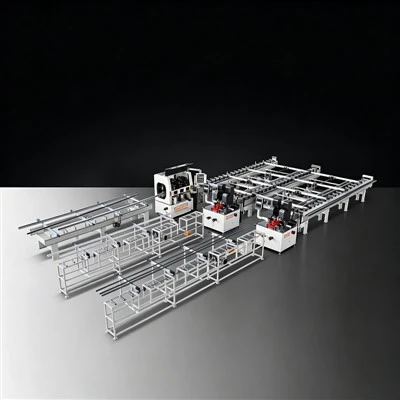
Complete Thermal Break Assembly Line
For higher production requirements, the individual processes can be integrated into an automated production line.
The level of automation depends on:
Production volume
Profile variety
Profile dimensions
Number of operators
Required changeover time
Factory layout
Quality requirements
MAKERL Thermal Break Assembly Solutions
For manufacturers producing polyamide-based thermally broken aluminum profiles, the assembly process is not simply a matter of inserting a plastic strip into an aluminum extrusion.
The production line needs to control the entire process from groove preparation to final rolling.
This is where MAKERL focuses its equipment solutions.
MAKERL develops machinery for the production of thermally broken aluminum profiles, including equipment for:
Polyamide strip insertion
Automated profile conveying
Integrated thermal break assembly
The equipment can be configured around different profile dimensions and production requirements, allowing manufacturers to build either individual processing stations or a more complete thermal break assembly line.
For manufacturers working with multiple aluminum profile designs, automation can also help reduce manual handling and improve process repeatability.
The key objective is straightforward:
Prepare the aluminum profile accurately, insert the thermal barrier consistently, and create a stable mechanical connection through controlled rolling.

Thermal Break Assembly Line: From Aluminum Extrusion to Finished Profile
A complete production workflow can be summarized as follows:
1. Aluminum Extrusion
The aluminum profiles are produced with specially designed thermal-break pockets.
↓
2. Profile Feeding
The profiles are positioned and fed into the processing line.
↓
3. Knurling
The thermal-break pockets are mechanically prepared.
↓
4. Polyamide Strip Insertion
The selected thermal barrier strips are inserted into the aluminum pockets.
↓
5. Profile Rolling
Controlled rolling pressure locks the aluminum and polyamide components together.
↓
6. Profile Correction and Conveying
The assembled profile can be handled and corrected as required.
↓
7. Quality Inspection
The finished profile is checked for dimensions, appearance, alignment, and connection quality.
↓
8. Finished Thermally Broken Aluminum Profile
The completed profile can then be used for windows, doors, curtain walls, sliding systems, skylights, and other building applications.
FAQ About Thermally Broken Aluminum Profiles
What is a thermally broken aluminum profile?
A thermally broken aluminum profile is an aluminum extrusion system in which the interior and exterior aluminum sections are separated by a low-conductivity thermal barrier. The design reduces heat transfer through the aluminum frame.
What is the difference between thermal break and thermally broken aluminum?
"Thermal break" refers to the insulating barrier or the separation created within the aluminum profile.
"Thermally broken aluminum" generally refers to the finished aluminum profile or system incorporating that barrier.
Both terms are widely used in the industry.
Are thermally broken aluminum profiles common in Europe?
Yes. Thermally broken aluminum systems are widely used in European windows, doors, façades, curtain walls, and other building envelope applications.
Mechanically assembled polyamide thermal barriers are an important technology in the European market.
Are thermally broken aluminum profiles used in North America?
Yes.
North American manufacturers use both polyamide thermal barrier strips and poured-and-debridged thermal barrier systems. FGIA specifically identifies these as the two principal thermal barrier approaches used in North America.
What is PA66 GF25?
PA66 GF25 refers to polyamide 66 reinforced with approximately 25% glass fiber.
It is commonly used for structural thermal barrier applications where the material needs both low thermal conductivity and mechanical stability.
Why does aluminum need a thermal break?
Aluminum is highly thermally conductive.
A thermal break interrupts the direct conductive path between the exterior and interior aluminum sections, helping reduce heat transfer through the frame.
What is thermal break knurling?
Thermal break knurling is the process of mechanically preparing the aluminum pocket before the thermal barrier strip is inserted.
The knurled surface helps establish the mechanical connection between the aluminum and the polyamide strip.
What is thermal break rolling?
Thermal break rolling is the process of applying controlled mechanical pressure to the aluminum sections after the thermal barrier has been inserted.
The rolling operation locks the components together and creates the finished composite profile.
What is the difference between polyamide and pour-and-debridge thermal breaks?
Polyamide systems use pre-extruded insulating strips that are mechanically assembled into aluminum profiles.
Pour-and-debridge systems use a polyurethane-based material that is poured into a channel, cured, and then debridged.
The two technologies require different production processes and equipment.
Conclusion
Thermally broken aluminum profiles are not a single standardized product type.
In Europe and North America, they are used across a wide range of applications, including windows, doors, sliding doors, curtain walls, storefronts, skylights, and high-performance building envelopes.
The main thermal barrier technologies also differ between markets.
Polyamide thermal barrier systems use a mechanically assembled strip between separate aluminum sections, while pour-and-debridge systems use a cured polymer thermal barrier formed inside the aluminum profile.
For polyamide systems, the manufacturing process typically involves:
Knurling → Strip Insertion → Rolling
Each stage contributes to the quality of the finished thermal-break profile.
As demand for energy-efficient aluminum windows, doors, and façades continues to grow, manufacturers need production equipment capable of handling different profile designs while maintaining consistent assembly quality.
For manufacturers using mechanically assembled polyamide thermal barriers, MAKERL provides thermal break knurling machines, strip insertion equipment, rolling machines, and integrated thermal break assembly line solutions designed around the production process from aluminum profile preparation to finished thermally broken profiles.
The right equipment ultimately depends on the profile design, thermal barrier specification, production capacity, level of automation, and target market.