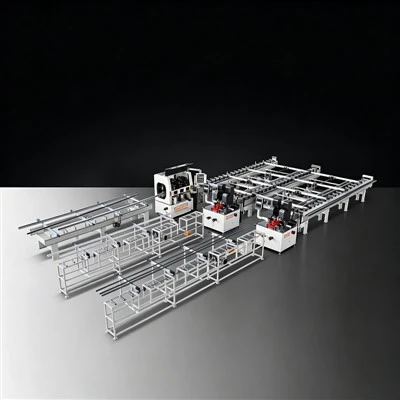
The core logic for choosing aluminum alloy strip insertion equipment is to match your factory size, order type, and production capacity requirements, prioritizing accuracy, stability, and after-sales support. Specifically, you can follow these 5 steps to select the right equipment:
Determine the configuration and budget based on your factory size.
For newly established small processing plants (mainly handling individual home decoration orders, monthly production capacity <500 sets): Choose a cost-effective basic tooth-cutting and strip insertion integrated machine. A budget of 20,000-40,000 RMB is sufficient. Don't blindly pursue high-end CNC configurations; meeting basic production needs is enough to reduce initial investment risk.
For medium-sized processing plants (handling both bulk home decoration orders and small project orders, monthly production capacity 500-2000 sets): Choose an integrated model with CNC adjustment. A budget of 35,000-60,000 RMB is recommended. Prioritize models that support both independent operation and integrated production lines, so you don't need to replace the equipment when expanding production capacity later. Large-scale system window and door manufacturer (high-end projects, monthly capacity > 2000 sets): Directly select a high-precision, fully automated production line configuration, with a budget of over 60,000 RMB. Requirements include support for non-standard customization and full-process CNC adjustment to ensure the precision stability of high-end orders.
Key Parameter Selection: Don't just look at the CNC system brand; focus on the hidden parameters affecting precision stability:
Frame Thickness: Reliable manufacturers should have a frame thickness of at least 12mm, preferably a 15mm thicker model to avoid frame deformation and precision drift after long-term continuous operation.
Core Component Brands: Select well-known brand linear guides with gaps controlled within 0.02mm to prevent cutting deviation; prioritize industrial-grade motors to ensure long-term operational stability.
Adjustment Compatibility: Confirm that the equipment can adapt to the range of profile sizes you frequently process. Prioritize models that support CNC adjustment to significantly reduce new employee training time.
Prioritize reputable original manufacturers and avoid white-label traps.
Always choose original factories with physical, standardized workshops. Request on-site visits to observe the production process and quality control. Avoid white-label manufacturers that claim to be original factories but lack physical workshops.
Confirm after-sales service: Prioritize manufacturers with nationwide after-sales service networks that can provide on-site installation, commissioning, and original parts supply. This avoids equipment malfunctions and delays in production.
Beware of low-price traps: While white-label equipment may be 30% cheaper than reputable manufacturers, it often uses refurbished motors and generic guide rails. Precision will decline within six months, and the resulting rework and downtime losses far outweigh the initial savings.